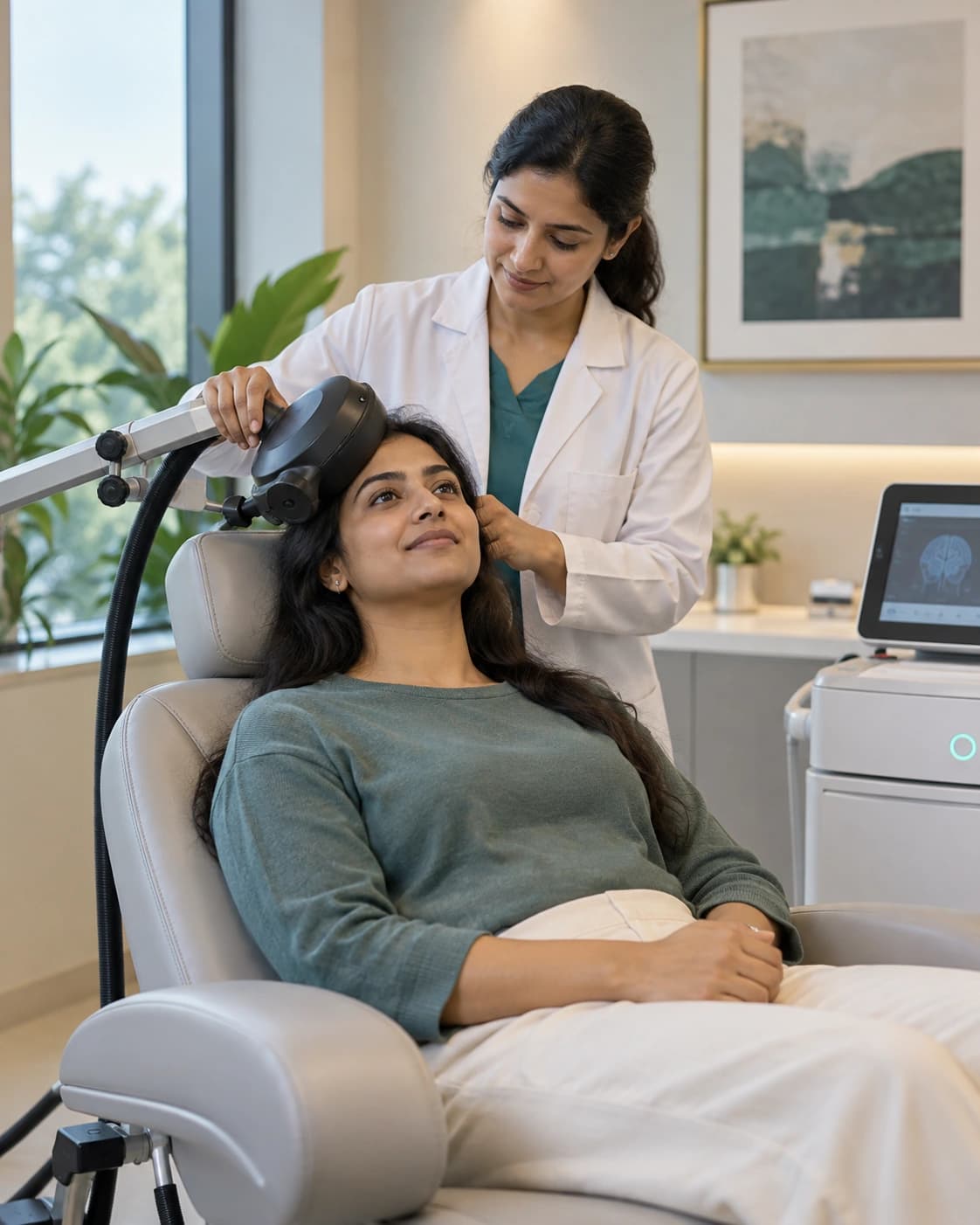
Repetitive transcranial magnetic stimulation (rTMS) is now an established part of modern psychiatric care, particularly for depression that has not responded well to medication. This guide explains what rTMS is, how it works, who it may help, what a course involves, what the evidence shows, and how it is approached at ReACH Psychiatry in Bangalore. It is written for patients and families and is intended for education. It does not replace an individual assessment with a qualified clinician.
What is rTMS?
Repetitive transcranial magnetic stimulation (rTMS) is a non-invasive brain-stimulation treatment that uses rapidly changing magnetic fields to influence targeted neural circuits. A treatment coil is positioned against the scalp while the patient remains awake, and the device delivers repeated magnetic pulses to a specific area of the brain.
The word “repetitive” matters. A single pulse briefly affects the tissue beneath the coil; rTMS instead delivers many pulses in patterned trains across a session, and a session is repeated over a planned course.
The underlying principle is electromagnetic induction: a changing magnetic field passing through the scalp induces small electrical currents in the cortex just beneath it, which can stimulate nearby neurons. Because those neurons are connected to wider brain networks, repeated, targeted stimulation is used to influence the activity of the circuits involved in conditions such as depression, an approach often described as neuromodulation.
rTMS is “non-invasive” because nothing is implanted and no surgery is involved, and it does not require anaesthesia. It is also distinct from electroconvulsive therapy (ECT): rTMS is not designed to induce a seizure and is carried out while you are awake.
How rTMS works
At a practical level, the sequence of a treatment is straightforward even though the neuroscience behind it is complex:
- A magnetic treatment coil is placed against the scalp
- A rapidly changing magnetic field passes painlessly through the scalp and skull
- The field induces small electrical currents in the tissue beneath it
- Targeted neurons in the cortex are stimulated
- Repeated sessions are used to influence activity in the connected neural circuits
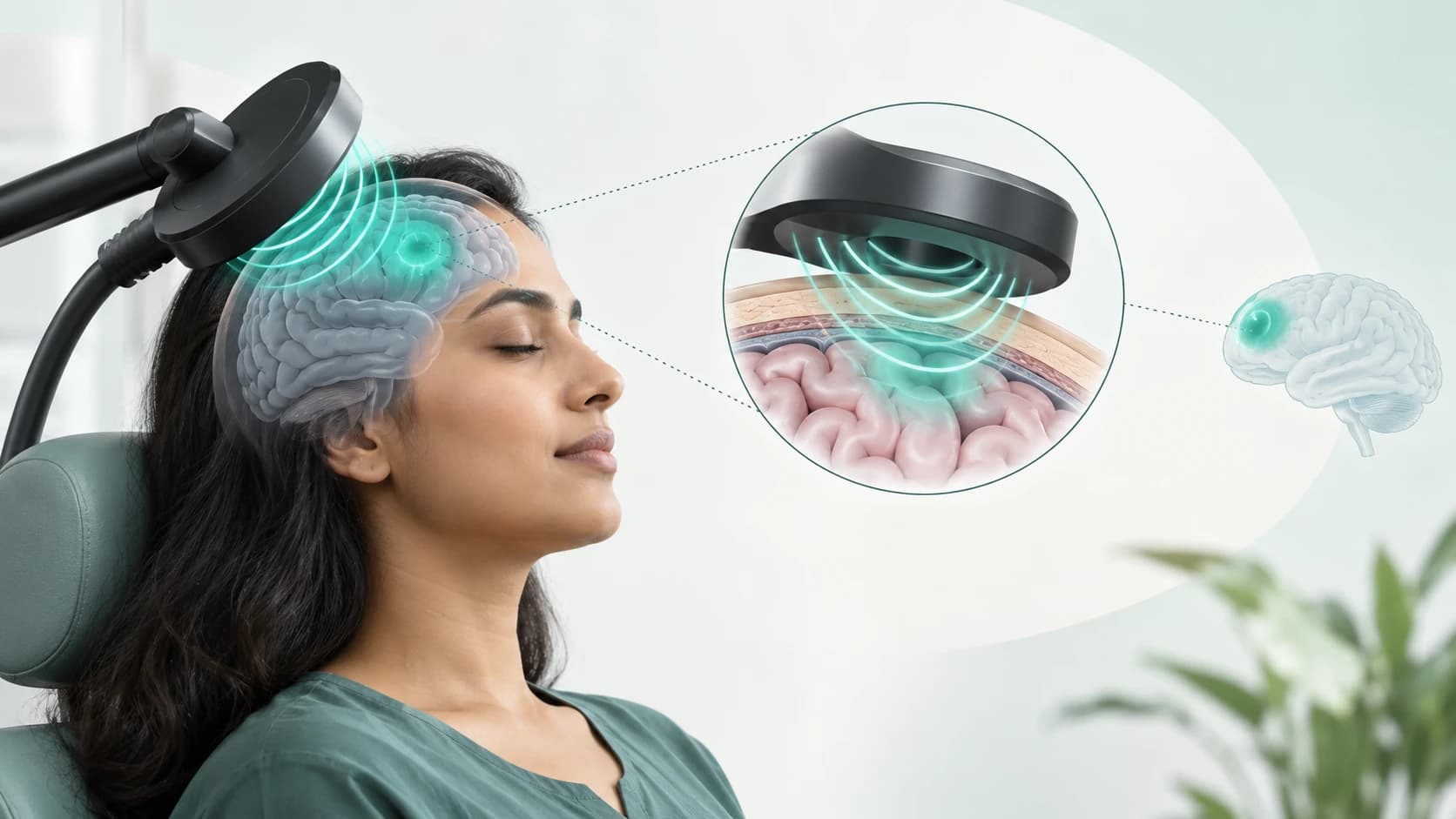
The target most commonly used for depression is a region of the prefrontal cortex involved in mood regulation. The device settings, including the strength and pattern of the pulses, are chosen by the clinical team, and in many protocols the treatment is individualised by first determining your motor threshold (the stimulation level that produces a small movement, used as a reference point). The aim is not a one-off effect but a gradual, cumulative influence on the relevant circuits over a course of sessions.
FDA clearance & regulatory history
Regulatory status is often misunderstood, so it is worth being precise. In the United States, TMS devices are generally FDA-cleared (permitted to be marketed) rather than “FDA-approved” in the sense used for medicines. The two terms describe different regulatory pathways.[1]
- • TMS was first cleared in the United States for the treatment of major depressive disorder in 2008, following a multisite randomized controlled trial.[1][4]
- • Later device and protocol clearances expanded the recognised indications. For example, deep TMS received clearance for obsessive-compulsive disorder in 2018.[1][10]
- • Device, protocol and diagnosis all matter: a clearance applies to a specific device used with a specific protocol for a specific indication.
In other words, it would be inaccurate to say that every rTMS device, every stimulation protocol and every psychiatric diagnosis share the same regulatory status. Regulatory frameworks also differ between countries; in the UK, for example, NICE has published guidance supporting the use of rTMS for depression with normal arrangements for consent and audit.[11]
Conditions rTMS is used for
The evidence for rTMS is not the same across every condition, and a responsible summary has to reflect that hierarchy rather than imply rTMS treats everything equally.
Treatment-resistant depression (the strongest evidence)
The best-established use of rTMS is in major depressive disorder, particularly when depression has not responded adequately to antidepressant medication, often called treatment-resistant depression. “Inadequate response” usually means a person has tried one or more antidepressants, at an appropriate dose and duration, without sufficient improvement.
A psychiatrist may consider rTMS in this situation for several reasons: it does not add to the systemic (whole-body) side-effect burden of medication, it is non-invasive, and it has a substantial evidence base in depression.
Importantly, rTMS is not reserved only for people who have exhausted every possible treatment. It may be considered at different points in a treatment plan, and that decision is individual. This is the largest and most established application, which is why it receives the most attention in this guide and in the evidence section below.
Other clinical applications
Beyond depression, rTMS has been studied and, for some device/protocol combinations, cleared for other conditions. The strength of the evidence differs by diagnosis and protocol:
- • Obsessive-compulsive disorder (OCD): deep TMS has regulatory clearance for OCD in some jurisdictions, supported by a randomized controlled trial.[10]
- • Anxiety symptoms and selected anxiety disorders: rTMS has been studied here, with some promising findings, though the evidence is more limited and heterogeneous than for depression (see the next section).[12]
- • Other and emerging psychiatric applications: research continues in areas such as certain aspects of PTSD and other conditions; these should be understood as areas of ongoing study rather than settled, universal indications.
Athletes are one group who sometimes ask about rTMS, because depression and anxiety can affect training, recovery and performance; we discuss this in more detail in rTMS, depression and anxiety in athletes.
rTMS and anxiety
Anxiety is one of the most common questions patients raise about rTMS, so it deserves a careful, honest answer. rTMS has been studied for anxiety symptoms and for several anxiety disorders, and some of this research is promising. For example, reductions in anxiety symptoms have been reported in selected populations, including when anxiety occurs alongside depression.[12]
At the same time, the evidence base for anxiety is generally smaller and more mixed than it is for major depression, and it is not accurate to describe rTMS as broadly “FDA-approved for anxiety disorders” as a blanket statement. Regulatory status depends on the specific condition, device and protocol. Whether rTMS is a reasonable option for a particular person’s anxiety is a clinical judgement that requires an individual psychiatric assessment. We explore this topic further in Is rTMS used for anxiety?
Who may be a candidate for rTMS?
Candidacy is always decided individually, but it can help to understand the kinds of factors a psychiatrist weighs up.
rTMS may be considered when…
- • there is a diagnosis for which rTMS has good evidence, such as depression
- • antidepressant medication has not helped enough, or is not well tolerated
- • a person prefers to avoid, or add to, medication where clinically reasonable
- • the person is able to attend the planned treatment schedule
- • safety screening does not identify a barrier to treatment
rTMS may need extra assessment, or may not be appropriate, when…
- • there is a history of seizures or certain neurological conditions
- • there are implanted or magnetic-sensitive devices near the treatment area
- • medications or medical conditions may affect the seizure threshold
- • the clinical picture points more strongly to another treatment first
- • attending frequent sessions is not currently feasible
These lists are general considerations, not a self-diagnosis tool. Candidacy must be determined after an individual psychiatric and safety assessment.
Key takeaway
rTMS candidacy depends on diagnosis, treatment history, medical history and individual safety screening, not on any single factor, and not on a checklist a person can score themselves.
The rTMS treatment process
A typical pathway moves through assessment and screening, into the treatment course, and then into review and follow-up:
Psychiatric assessment
A psychiatrist reviews your diagnosis, symptoms, treatment history and goals to consider whether rTMS is a reasonable option for your situation.
Safety screening
Medical, neurological and device history are reviewed, including any implanted or electronic devices, to check that treatment can be delivered safely.
Mapping / motor-threshold
Where the protocol requires it, the team determines your motor threshold and locates the treatment target so stimulation is individualised rather than generic.
Treatment sessions
You attend a planned course of sessions. You remain awake and seated throughout, and can speak with the team during treatment.
Progress review
Symptoms are reviewed during the course using clinical judgement and, where useful, standardised rating scales, so the plan can be adjusted.
Follow-up / maintenance
After the acute course, the psychiatrist discusses next steps, which may include continued care and, where clinically appropriate, maintenance sessions.
What happens before treatment matters as much as the sessions themselves. The psychiatric assessment establishes the diagnosis and treatment goals; safety screening checks that treatment can be delivered safely; and, where the protocol requires it, mapping and motor-threshold determination make the treatment specific to you rather than a generic setting.
What happens during an rTMS session
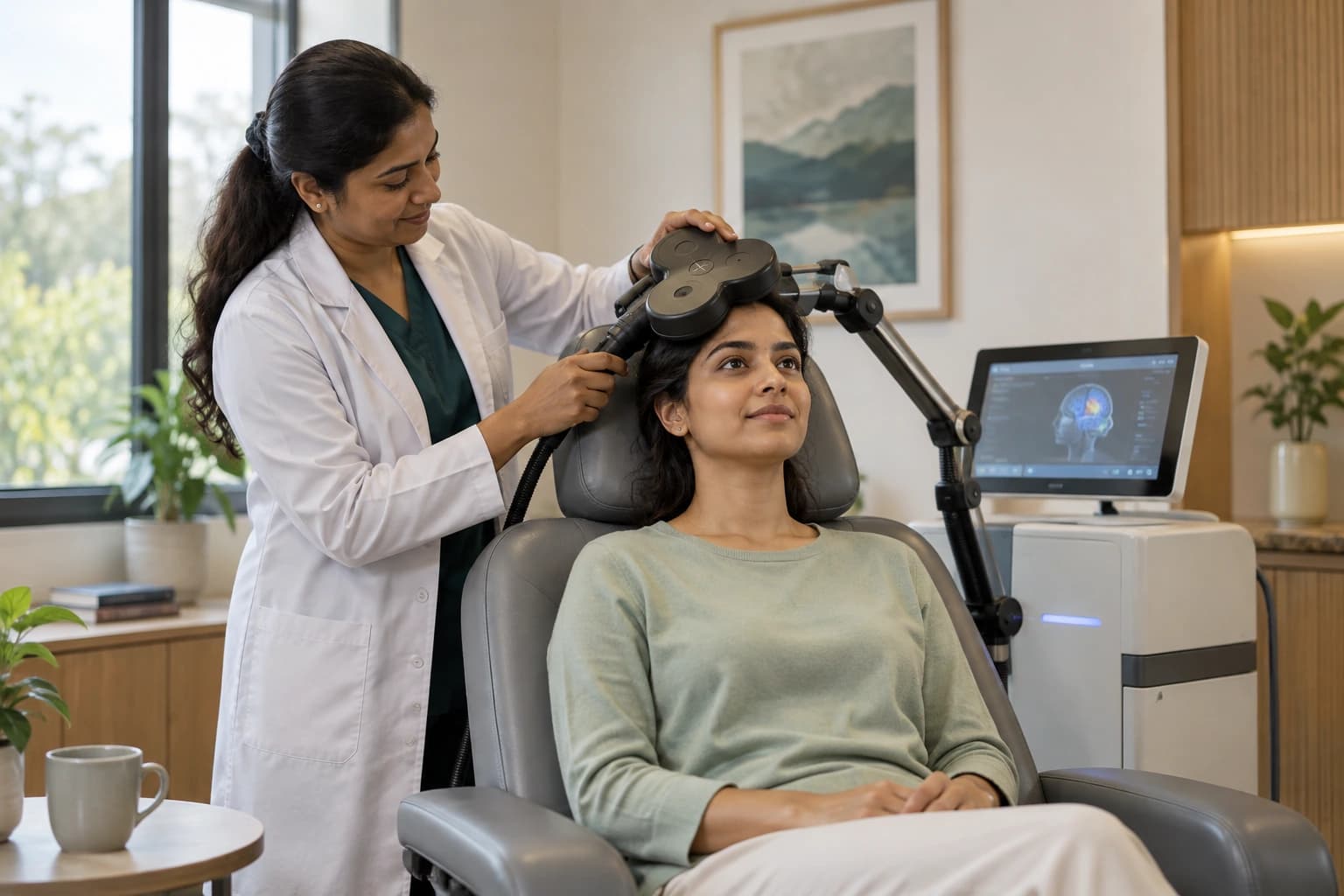
During a session you are seated comfortably and remain awake throughout. The treatment coil is positioned against your scalp over the target area, and the device delivers the magnetic pulses. Most people describe a tapping or clicking sensation, and some tightening or twitching of nearby scalp and facial muscles can occur. You can communicate with the staff during treatment, and no general anaesthesia is used, so many people are able to return to their usual activities afterwards, with guidance from the clinician based on how they respond.
Treatment schedule & course
Treatment schedules vary by protocol, device and condition, so no single schedule is universal. A common conventional course involves sessions on five weekdays per week for approximately four to six weeks (an “acute” course), after which progress is reviewed.
- • the number of sessions, the number of pulses per session, and the session length can all differ between protocols;
- • progress is typically reviewed during the course, and the plan can be adjusted;
- • where clinically appropriate, some people go on to have maintenance or “booster” sessions after the acute course;
- • newer and accelerated protocols exist (delivering treatment over a shorter calendar period), but they are not automatically suitable for everyone and depend on individual assessment.
When improvement may appear
rTMS is not an instant treatment, and the timing of any benefit varies from person to person. Some people begin to notice change within the first couple of weeks, while for others improvement builds more gradually across the course; some people do not respond. Because the response is individual, symptoms are reviewed during treatment, using clinical judgement and, where useful, standardised rating scales, so that the plan can be adjusted rather than assumed to be working.
What does the evidence actually show?
Two terms are used throughout the research, and understanding them makes the evidence far easier to interpret:
- Response
- A clinically meaningful reduction in symptoms, commonly defined in studies as at least a 50% fall on a depression rating scale.
- Remission
- Symptoms falling below a study-defined threshold, i.e. the person is essentially no longer in a depressive episode by that measure.
For depression, the evidence comes from two complementary kinds of research. In controlled trials, a 2024 meta-analysis of five randomized controlled trials (507 patients) of deep TMS in treatment-resistant depression reported a response rate of 45.3% with active treatment versus 24.2% with sham, and remission of 38.3% versus 14.4% with sham.[14] These figures apply to deep TMS specifically and should not be read as a number for every rTMS device or protocol. In real-worldroutine care, a large clinical-outcomes registry reported response in roughly 58–83% of patients and remission in roughly 28–62%[13]. This is a wide range precisely because the figure moved with the outcome scale used, whether it was clinician- or patient-rated, and whether it counted everyone who started (intention-to-treat) or only those who completed the course. A major head-to-head trial also found a briefer protocol (intermittent theta burst) non-inferior to conventional rTMS.[8]
Swipe horizontally to see the full table →
| Study / population | Evidence type | What was measured | Reported result | Important limitation |
|---|---|---|---|---|
| Major depression (real-world registry) [13] | Registry / routine care | Response + remission | Response 58–83%; remission 28–62% | Open-label registry; rates varied by outcome scale, clinician- vs patient-rating, and ITT vs completer sample |
| Deep TMS for treatment-resistant depression [14] | 5-RCT meta-analysis (507 patients) | Response + remission vs sham | Response 45.3% vs 24.2%; remission 38.3% vs 14.4% | Deep TMS specifically, not all rTMS devices or protocols |
| Generalised anxiety disorder (GAD) [15] | 6-study meta-analysis (152 patients) | Anxiety symptom change (effect size) | SMD −1.857 (95% CI −2.219 to −1.494; P < .001) | Small, heterogeneous evidence base; needs larger rigorous trials |
| Obsessive-compulsive disorder (OCD) [17] | FDA-reviewed randomized trial (100 patients) | Y-BOCS response (>30% reduction) | Response 38% vs 11% sham | A specific deep-TMS system and protocol; not depression or anxiety |
This is why the page shows ranges tied to specific studies rather than one headline “success rate.” Outcomes differ by study design, protocol, device, depression severity, degree of treatment resistance, the scale used and course completion. The honest summary: rTMS helps a meaningful proportion of people with treatment-resistant depression, response is more likely than with sham, and no result is guaranteed for any individual.
For anxiety, the evidence is quantitative but younger. A 2022 meta-analysis of six studies (152 patients) in generalized anxiety disorder found a large pooled reduction in anxiety scores (a standardized mean difference of −1.857, 95% CI −2.219 to −1.494; P < .001).[15] In plain terms, the pooled studies showed a substantial fall in anxiety symptoms, but the evidence base was small and varied, and needs larger, rigorous trials before firm conclusions. A broader 2022 review (13 studies, 677 participants) similarly found significant improvement for generalized anxiety disorder while panic-disorder outcomes were less clear[16]. This is a reminder that “anxiety disorders” are not one uniform indication, and that the depression figures above should not be assumed to apply to anxiety.[12]
The OCD row reflects regulatory-grade evidence in a third condition: the trial the FDA reviewed for deep TMS in OCD reported a Y-BOCS response (a greater-than-30% symptom reduction) in 38% of actively treated patients versus 11% with sham, a figure specific to OCD and to that device and protocol, not to depression or anxiety.[10][17]
Safety & side effects
rTMS is generally well tolerated, and most side effects are mild and temporary. It is still a medical treatment, so it is delivered by a trained team after appropriate screening.
Common and usually temporary
- • scalp discomfort or tenderness at the treatment site
- • headache
- • a tapping sensation during treatment
- • twitching or tightening of local scalp and facial muscles
Rare but important
The most important rare risk is a seizure. This is uncommon, particularly when established safety guidelines and screening are followed, but it is the reason seizure history and seizure-threshold-lowering factors are carefully reviewed before treatment.[3][9]
Why screening matters
Because rTMS uses a strong, rapidly changing magnetic field, implanted or magnetic-sensitive devices near the treatment area need careful assessment. Examples that may require particular care include cochlear implants, implanted electrodes or stimulators, and certain aneurysm clips or coils and other metallic or electronic devices near the head. Importantly, having metal somewhere in the body does not by itself mean a person cannot have rTMS. It is one of several factors the team assesses. This page cannot provide individualised medical clearance; that comes from your assessment.
Contraindications & screening
Before treatment, a trained clinical team screens a range of factors to decide whether rTMS can be delivered safely and appropriately. These commonly include:
- • neurological history and any history of seizures
- • medications that may affect the seizure threshold, where relevant
- • implanted, metallic or electronic devices, especially near the head
- • relevant medical history and previous treatment
- • pregnancy and other health considerations, where clinically appropriate
This is not an exhaustive checklist or medical advice. It is an outline of the kind of review a careful service carries out. The purpose of screening is not to find reasons to refuse treatment, but to make sure treatment is safe and suitable for the individual.
How rTMS compares with other treatments
Patients often want to see rTMS alongside the other main options. The table below compares them across some practical dimensions. It is not a ranking: different treatments suit different clinical situations, and the “best” option is the one that fits a particular person’s illness, history and circumstances.
Swipe horizontally to compare all treatments →
| Dimension | rTMS | Medication | ECT | Ketamine / esketamine | Psychotherapy |
|---|---|---|---|---|---|
| Non-invasive | Yes | Yes (oral) | No (a medical procedure) | Depends on route (e.g. IV or nasal spray) | Yes |
| General anaesthesia | No | No | Yes | No (monitored administration) | No |
| Systemic (whole-body) medication effects | No | Yes (acts throughout the body) | Anaesthetic medication is used for the procedure | Yes (a systemic medication with monitoring) | No |
| Regular clinic attendance | Yes (a course of sessions) | No (taken at home with review visits) | Yes (scheduled treatments) | Yes (supervised, monitored dosing) | Yes (scheduled sessions) |
| A common clinical role | Often considered in depression that has not responded adequately to medication | A first-line treatment for many people with depression and anxiety | An important, highly effective option for severe, urgent or resistant illness | May be considered in selected treatment-resistant depression | A core treatment on its own or alongside other options |
| Memory / cognitive considerations | Not typically associated with memory loss | Varies by medication; some cognitive/other side effects possible | Temporary memory effects can occur around treatment | Short-term dissociative and other effects during/after dosing | No medication or procedure effects |
| Typical course | A daily (weekday) course over several weeks | Ongoing daily dosing | A course of treatments, often with anaesthesia | A supervised dosing schedule | A course of sessions over weeks to months |
A specific point of fairness: ECT is sometimes framed negatively in order to promote rTMS. That is not accurate or responsible. ECT remains an important and highly effective treatment, particularly for severe, urgent or treatment-resistant depressive illness, and for some people it is the most appropriate choice. Similarly, ketamine or esketamine treatment is a distinct, systemic option with its own indications and monitoring requirements, and is not simply interchangeable with rTMS.
Can rTMS be combined with medication and psychotherapy?
rTMS is usually part of a broader psychiatric treatment plan rather than a stand-alone fix. Depending on the individual, medication may continue during a course, psychotherapy may continue alongside it, and factors such as sleep, lifestyle and physical health may be addressed at the same time. Treatment is also reviewed and adjusted over time.
One point is essential: do not stop or change any medication on your own. Any medication change should be made together with your treating clinician, who can weigh it against your overall treatment plan. You can read more about the range of advanced psychiatric treatments at ReACH, of which rTMS is one part.
rTMS treatment at ReACH Psychiatry in Bangalore
rTMS at ReACH is delivered as part of a psychiatrist-led, evidence-led approach. That means treatment follows an individual psychiatric assessment and careful patient selection, and rTMS is considered within a wider treatment plan rather than offered in isolation.
Clinic
ReACH Psychiatry & Counselling Centre
319, 7th Main Road, CMR Main Road
HRBR Layout 2nd Block, Kalyan Nagar
Bengaluru, Karnataka 560043
Psychiatrist-led assessment
Dr. Meena Gnanasekharan
Consultant Psychiatrist
MD, DABPN · KMC Regn. No. 92604
Assessment and advanced-treatment planning at ReACH are led by a psychiatrist, so decisions about whether rTMS is appropriate are made clinically.
Consultation and follow-up across India
ReACH is based in Bangalore, and rTMS treatment itself requires attending the clinic in person. It cannot be delivered remotely. However, an initial psychiatric consultation, treatment-planning discussions and selected follow-up care may be available through telehealth for patients elsewhere in India, depending on clinical suitability and current clinic workflow. This can make it easier to have an informed conversation about whether travelling for a course of in-person treatment is worthwhile in your situation.
Frequently asked questions
Is rTMS painful?
Most people do not find rTMS painful. During treatment you may feel a tapping sensation on the scalp and some tightening of nearby muscles, and a mild headache or scalp tenderness afterwards is common and usually temporary. Tell the team if anything is uncomfortable, as settings can often be adjusted.
Is rTMS the same as ECT?
No. rTMS and ECT are different treatments. rTMS uses focused magnetic pulses while you are awake, does not require general anaesthesia, and is not designed to induce a seizure. ECT is a separate, highly effective procedure carried out under anaesthesia and remains important for certain severe or urgent situations. Which is appropriate depends entirely on the clinical picture.
How many rTMS sessions are usually needed?
A common conventional course involves sessions on five weekdays per week for roughly four to six weeks, though the exact number of sessions varies by protocol, device and the condition being treated. Your psychiatrist will explain the plan intended for you.
How long is an rTMS session?
Session length depends on the protocol and device and can range from a few minutes for some accelerated protocols to around 20–40 minutes for many conventional protocols. Your care team will tell you what to expect for your specific plan.
Can I continue antidepressants during rTMS?
rTMS is often delivered alongside ongoing psychiatric treatment, and many people continue their medication during a course. Any change to medication should be decided with your treating clinician. Never stop or adjust medication on your own.
How soon might improvement appear?
This varies from person to person. Some people notice change within the first few weeks, while for others improvement builds more gradually over the course, and some do not respond. Progress is reviewed during treatment so the plan can be adjusted.
Does rTMS cause memory loss?
rTMS is not typically associated with memory loss. This is one of the practical differences patients often ask about when comparing it with ECT. Any concerns about thinking or memory should be raised with your clinician.
Can I drive after an rTMS session?
Because rTMS does not use general anaesthesia and you remain awake, many people are able to resume usual daily activities after a session. Your clinician will give guidance based on how you respond and your individual circumstances.
Who may not be suitable for rTMS?
Suitability is decided after an individual assessment. Careful screening is needed for people with a history of seizures, certain neurological conditions, or implanted or magnetic-sensitive devices near the treatment area. Having metal in the body does not automatically rule out rTMS. It is one of several factors the team reviews.
Where is rTMS available at ReACH in Bangalore?
rTMS at ReACH Psychiatry & Counselling Centre is provided at the clinic in Kalyan Nagar, Bengaluru. Treatment itself is delivered in person; an initial psychiatric consultation and selected follow-up may be available by telehealth for patients elsewhere in India, depending on clinical suitability.
Evidence & further reading
View the clinical references used in this guide
This guide draws on regulatory bodies, national health institutes, peer-reviewed reviews and trials, and established medical centres.
- [1]U.S. Food & Drug Administration. Transcranial magnetic stimulation (TMS): device classification and 510(k) clearances. Source
- [2]National Institute of Mental Health (NIMH). Brain Stimulation Therapies. Source
- [3]Mayo Clinic. Transcranial magnetic stimulation: overview, what to expect and risks. Source
- [4]O’Reardon JP, et al. Efficacy and safety of transcranial magnetic stimulation in the acute treatment of major depression: a multisite randomized controlled trial. Biological Psychiatry. 2007. Source
- [5]George MS, et al. Daily left prefrontal transcranial magnetic stimulation therapy for major depressive disorder: a sham-controlled randomized trial. Archives of General Psychiatry. 2010. Source
- [6]Carpenter LL, et al. Transcranial magnetic stimulation (TMS) for major depression: a multisite, naturalistic, observational study of acute treatment outcomes in clinical practice. Depression and Anxiety. 2012. Source
- [7]Berlim MT, et al. Response, remission and drop-out rates following high-frequency repetitive transcranial magnetic stimulation (rTMS) for treating major depression: a systematic review and meta-analysis of randomized, double-blind and sham-controlled trials. Psychological Medicine. 2014. Source
- [8]Blumberger DM, et al. Effectiveness of theta burst versus high-frequency repetitive transcranial magnetic stimulation in patients with depression (THREE-D): a randomized non-inferiority trial. The Lancet. 2018. Source
- [9]Perera T, et al. The Clinical TMS Society consensus review and treatment recommendations for TMS therapy for major depressive disorder. Brain Stimulation. 2016. Source
- [10]Carmi L, et al. Efficacy and safety of deep transcranial magnetic stimulation for obsessive-compulsive disorder: a prospective multicenter randomized double-blind placebo-controlled trial. American Journal of Psychiatry. 2019. Source
- [11]National Institute for Health and Care Excellence (NICE). Repetitive transcranial magnetic stimulation for depression (Interventional procedures guidance IPG542). 2015. Source
- [12]Cirillo P, et al. Transcranial magnetic stimulation in anxiety and trauma-related disorders: a systematic review. Brain and Behavior. 2019. Source
- [13]Sackeim HA, et al. Clinical outcomes in a large registry of patients with major depressive disorder treated with transcranial magnetic stimulation. Journal of Affective Disorders. 2020. Source
- [14]Systematic review and meta-analysis of deep transcranial magnetic stimulation for treatment-resistant depression (5 randomized controlled trials, 507 patients). 2024. Source
- [15]Parikh TK, et al. Repetitive transcranial magnetic stimulation for generalized anxiety disorder: a systematic review and meta-analysis (6 studies, 152 patients). 2022. Source
- [16]Systematic review and meta-analysis of transcranial magnetic stimulation for anxiety disorders (13 studies, 677 participants): significant improvement in generalized anxiety disorder, with less clear effects for panic disorder. 2022. Source
- [17]U.S. Food & Drug Administration. FDA permits marketing of transcranial magnetic stimulation for treatment of obsessive-compulsive disorder (2018). Reviewed trial: 38% vs 11% response (>30% Y-BOCS reduction), 100 patients. Source
This page is for general education and does not constitute medical advice, diagnosis or a treatment recommendation for any individual. Whether rTMS is appropriate for you can only be determined through an individual assessment with a qualified clinician.